Beyond the screen
What if the next useful gadget was one you built yourself?
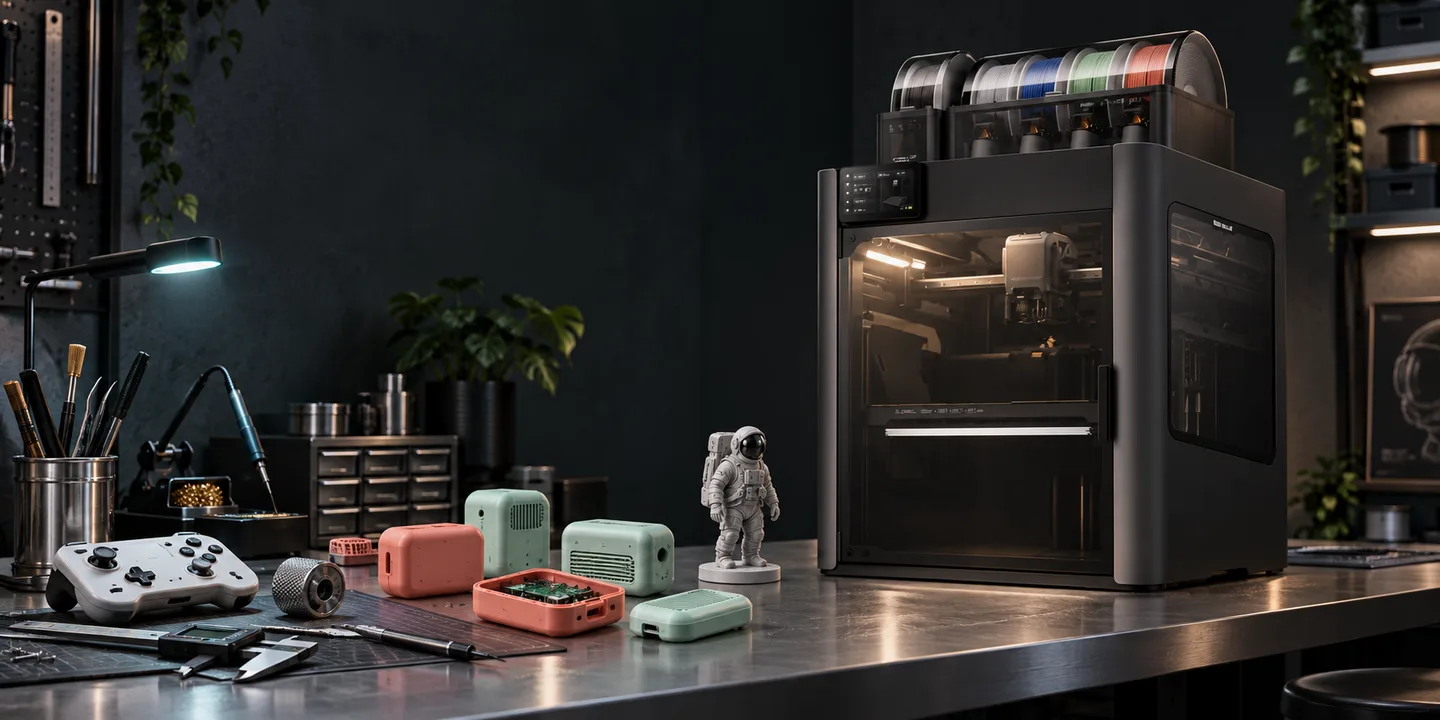
A case, one layer at a time.
A PCB is only part of a gadget. The case has to hold the board, leave room for the ports, and survive being picked up.
A few seconds here. Many more layers on the H2C.
Some ideas need more than a screen. I use my Bambu Lab H2C to print miniatures, custom enclosures, and parts for consumer gadgets. This is the physical side of the same curiosity that drives my software work. It is an ongoing exploration rather than a released gadget catalog.
A circuit needs a home
An enclosure is part of how a gadget feels. The electronics have to fit inside it, the ports have to be reachable, and the object has to make sense in your hand. Printing an enclosure makes those questions tangible.
The interesting part for me is bringing the software, electronics, and physical object into one build. An application has an interface; so does a button, a connector, or a lid. There is something satisfying about making the pieces belong together.
Miniatures belong here too
Not every print has to solve a practical problem. I also print miniatures. The details and the simple pleasure of seeing a small object take shape are reasons enough to make something.
I bring the same curiosity to games, unboxing technology, and trying new equipment on GamesPatch, my YouTube channel with 5K+ subscribers.
An open workbench
Try the enclosure above: open the shell, inspect the board, and wake its display. It is a design demo, not a released gadget. The H2C, miniature printing, and enclosure building are part of my own setup and practice.
What if the next small thing I want to use is something I can build myself?
Sources & further reading
What I built, and the history behind it, is my first-person account. The links above back up the product descriptions and implementation details.
 Talk to me on LinkedIn